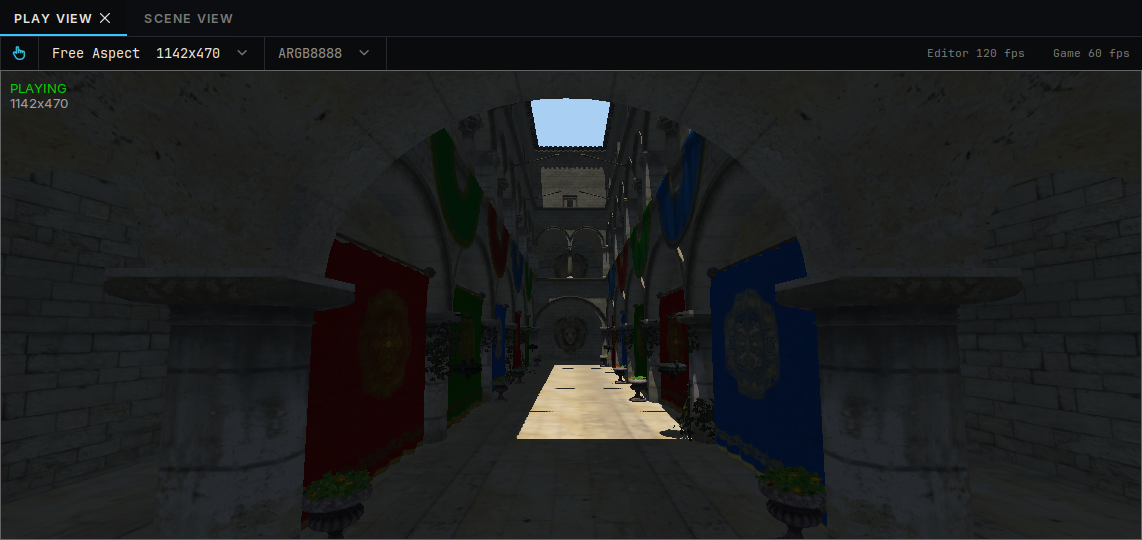
3D
The new deki-3d package draws meshes in the same frame as the 2D, with one sort order, so a UI sits over a 3D scene as over any other.
- On a board it is a software rasteriser. It draws in tiles, so the depth
buffer is one tile: 2 KB at 32 pixels, not the 150 KB of a full 320x240 one.
- A 2,000-triangle textured corridor on a T-Deck: 20 frames a second.
- Sponza, at 82,000 triangles, runs on a T-Deck at 1.3.
- On a Miyoo Mini, a 6,000-triangle scene holds 60.
- On the desktop it draws with OpenGL, with shadows and shaders.
- Models come from
.objfiles, at any size. Each platform’s build keeps a share of the triangles (Detail), and the textures follow their images’ settings for that platform. A board build stops when a model will not fit the board’s memory. - The camera draws meshes when its projection is Perspective.
deki-3d is experimental: its properties and file format may still change.
Lights
One Light component lights both meshes and the 2D world: Ambient,
Directional, Point or Spot, with a colour and an intensity.
- 2D on a board is lit on the CPU, so a T-Deck gets light pools and night scenes. Set Bands to 2–8 for hard, dithered rings: the pixel-art look.
- 2D on the desktop is lit on the GPU, per pixel.
- The camera’s Lit Up To Sort Order keeps the UI out of the light.
- Shadows on the GPU, from up to two directional or spot lights a frame. A board without OpenGL draws the light without its shadows, and its build says which lights.
- A game without a Light spends no memory on lights.
Shaders and the GPU
- HLSL shaders. A
.shaderon a mesh decides its colour (Shade()) and can move its vertices (Displace()), for grass or water. A Screen Effect runs one over the whole frame. - 2D on the GPU on the desktop: sprites, text and shapes go straight into the frame.
- Texture filters per platform: Point, Bilinear or Trilinear for each image. A board without a GPU draws Point and the inspector says so.
Miyoo Mini
The new deki-miyoo-boards package builds a game for the Miyoo Mini and installs it on the SD card, on stock firmware or Onion.
- 320x240 in ARGB8888, scaled 2x to the panel.
- A 6,000-triangle 3D scene at 60 frames a second, a 13,000-triangle one at a steady 30.
- MENU quits the game.
Tested on Onion. Stock firmware is not tested yet, and sound, battery and brightness are not in this version.
Also new
- Rename a project in Project Settings > Project > Name.
- Build errors say what failed: the package, the project’s code or the engine.
- The desktop target is called Desktop. It builds the PC version of a game for Windows, Linux or macOS.
- Tactility: sound and install over USB or Wi-Fi. Experimental: built, not yet seen running on a device.
- Games that run as a program start in the engine’s own
main(), the desktop’s and the Miyoo Mini’s alike, and free all their memory when they quit.
Updating
Opening a project made with 0.22 asks whether to upgrade it first. The
upgrade renames desktop-os to hosted and SIMULATOR to DEKI_HOSTED in
the project’s own files. Scenes and assets are not touched, and version
control shows every change. Cancel leaves the project as it is.
Its packages keep working as they are. Update them from the Package Manager,
or with DekiEditor --packages-update all <project>.
For package authors: package builds from 0.22 are rebuilt (reflection ABI 23).
Changelog ·Download the editor
Sponza: Frank Meinl (Crytek), after Marko Dabrovic’s original, from Morgan McGuire’s Computer Graphics Archive (CC BY 3.0).